Monday, 13 August 2012

A New Bend in the Road... the return of Jeremy Spencer by James Nuttall

Today, when most people hear the name Fleetwood Mac they automatically think 'Rumours'... the tenth biggest selling album of all time. An album that painted a musical picture of the personal traumas of the 1977 line up of the west-coast soft-rock phenomenon as they dealt with interpersonal break ups, the pressure of super stardom and drug addiction. They picture seventies siren Stevie Nicks twirling around in her chiffon skirts and Lindsey Buckingham's unique style of playing guitar.

This is the Fleetwood Mac you will be watching on Behind the Music. However, the big Mac had already been around since 1967 as one of the most successful blues bands on the British music scene, and already featured 10 members by the time Buckingham Nicks joined the group in 1975.

This Fleetwood Mac might get ten minutes devoted to them in a 60 minute documentary before the current line up's story takes over. However, the earlier line ups had just as much drama as any incarnation of the band.

Jeremy Spencer was, until 1971, was in the middle of this drama. As a founding member of the band, he played slide guitar on some of the early hits, such as 'Black Magic Woman' (later to be made a smash hit in America by Carlos Santana), 'Albatross' and 'Oh Well'. All three Fleetwood Mac albums to feature Spencer reached the top 10 in Britain. 

Things started to fall apart for the super group in 1970, when the bands' front man and lead guitarist, Peter Green, voted the third-greatest guitarist in the world by Mojo magazine, left the band after an ill-fated LSD trip in Munich. 10 days before a US tour, bass player John McVie's wife, Christine McVie, who used to front the blues band Chicken Shack joined the band on keyboards. She would go onto write some of the Mac's biggest hits for the next 20 years such as 'Don't Stop', 'Little Lies', 'Everywhere' and 'You Make Loving Fun'.
'Bend in the Road'  by Jeremy Spencer CD cover

Fleetwood Mac has used nine different guitar players since its formation, and each left at some stage. Jeremy was to be the second guitarist to leave. In 1971 he disappeared in Los Angeles outside a book store and was later found by the band's manager with a religious group, The Children of God. Spencer is still a member of this group today, although they are now named 'The Family International.' Mick Fleetwood recalled "It was like Scott of the Antarctic."

Band members often recalled Spencer reading a bible he had sewn into his coat, and that he was often much quieter than his charismatic and loud on-stage persona.

Jeremy had already released a solo album while he was in Fleetwood Mac, the 1970 LP 'Jeremy Spencer'. Another album was to follow in 1972 after he left the band, and then another in 1979. However, it would not be until 2006 that the world heard Spencer's fourth solo album, 'Precious Little'

Now in 2012 he has recorded a new album, 'Bend in the Road'. Sticking to his blues roots, Spencer covers an Elmore James track and gives us 14 blues tracks in total. A limited edition double album vinyl edition was released to coincide with Record Store Day, and the CD edition is due for release on 28 August.

I spoke to Jeremy via email to talk about his projects, old and new... 

Hi Jeremy, thanks for taking the time to do this interview.
You are welcome James. I like to do email interviews – at least I don’t get misquoted!

You were influenced by the blues musician Elmore James, and you cover 'The Sun Is Shining' on the new album. Can you remember where you first heard him, and have you a particular favourite song by him?
I came to hear Elmore James after a friend and fellow student named ‘Acker’ rescued me from a cruel prank at Stafford Art College one evening in 1964. He invited me for dinner and put on a blues album while we ate. It was a British Pye records compilation from Chess called The Blues Vol 3. It had Howling Wolf, Muddy Waters, Jimmy Witherspoon etc; good stuff, but it wasn’t grabbing my ear while we chatted, as I was preoccupied and down about the incident earlier.

Suddenly ‘The Sun is Shining’ by Elmore came on. I jumped up and stood mesmerised at the record player. I had never heard of him before and I couldn’t believe my ears. I think what grabbed me was Elmore’s singing and the answering of his guitar like one voice. It sounded so anguished and powerful.

From that point on, I was determined to play and if possible sing like that. Problem was, that was the only available song of his in England at the time until Sue records issued an album called ‘The Best of Elmore James’ which I obtained at the time of my fractured leg accident about nine months later.

Was it James that first attracted you to the slide guitar?
Absolutely.

Which of the Fleetwood Mac albums do you consider to be the best?
To be honest, for enjoyable, detached listening, I liked the first two albums they put out in the 70’s with Buckingham and Nicks the best - Fleetwood Mac’ and ‘Rumours’.

Do you consider 'Bend in the Road' your best solo work to date?
It’s difficult for me to decide between this one and my previous release in 2006: ‘Precious Little’. I consider them both my best by far.

Do you ever manage to come and play over in Europe anymore?
Actually, I do live in Europe. My wife is German, and we have been living in Germany. I have performed occasionally here in Europe over the last ten years, as well as in America.

You've written the majority of the songs on Bend in the Road; you also wrote  much of Fleetwood Mac's material when you were in the band. However, some of the songs on this new album were written in the 70's and 80's. How often do you find yourself writing songs?
I am always getting ideas, and I have a huge unfinished and unused backlog of 40 years on my computer and in my noddle! I just have to knuckle down and finish them. Opportunities like recording ‘Precious Little’ and ‘Bend in the Road’ force me to do so.

Do you tend to start with lyrics or melody when you write a song?
I usually start with a melody and maybe a lyric line or a title. Again, I usually have to push, or get pushed to finish the song! That’s where the hard work comes in. They say that inspiration is ninety percent perspiration!
Alternate cover for the vinyl edition of 'Bend in the Road'

You've used a lot of different guitars over the years, do you like to use any particular one to record with?
For recording, I like to use a 2008 limited edition PRS with three P90 pickups and a five-way switch. It gives a broad ‘palette’ and covers all the bases. I usually like to stick with only one or two electric guitars for a session, and just one for a gig.

Are you still in contact with the members of Fleetwood Mac?
I have regular contact (usually by phone) with Mick Fleetwood and John McVie.

Fleetwood Mac are planning a tour next year, do you think you will go and see them?
If they are around, and it’s a convenient trip, I’d like to.

What does your current touring band consist of?
I seldom tour, but when I do the occasional venue, I usually have a second guitarist, bassist, drummer and sometimes a keyboard player. I am concluding that I can do with either another guitarist or a keyboardist to share the solo spots; it’s unnecessary to have both. It must be something about the ‘less is more’ principle, where the individual instruments have more air and space.

I have also been encouraged with a recent experience playing as a duo with Papa George. We both played resonator guitars; it clicked amazingly and we could have played for hours!

Who do you enjoy listening to when you're at home?
I have a playlist of favourites from the 50’s and each decade until now, to which I occasionally listen. I like to listen to Mark Knopfler, Dido, Enya and Albert King to name a few, but as I said in answer to an earlier question, I have so many ideas in my head, that when I want to listen to music, I make it!

You've been a professional musician since the '60's, is there a particular highlight of your career, such as a stand-out show or album?
Norway with a team of Norwegian blues musicians, and collaborating with guitarist Brett Lucas in Detroit on ‘Bend in the Road’. A recent highlight has been briefly working with a young French guitarist, Mick Ravassat, with whom I hope to do more.

Finally, a must-ask question, do you think there is any chance of the original blues line up of The Mac getting back together, even for a one-off gig?
Maybe I should ‘quote’ Mark Knopfler’s response to a similar must-ask question in an interview -- with an ‘audible sigh’!

Bottom line, James, even if Peter and Danny were able to participate, which is unlikely, I would decline, despite the hypothetical cries of ‘do it for your fans.’

On that note, I would like to leave you with this quote from Steve Jobs, taken from his recent biography written by Walter Isaacson:‘If you want to live your life in a creative way, as an artist, you have to not look back too much. You have to be willing to take whatever you’ve done and whoever you were and throw them away.

‘The more the outside world tries to reinforce an image of you, the harder it is to continue to be an artist, which is why a lot of times, artists have to say, “Bye. I have to go. I’m going crazy and I’m getting out of here.” And they go and hibernate somewhere. Maybe later they re-emerge a little differently.’

Even though I remain true to my blues ‘roots’, I enjoy and need to keep moving forward musically, and I hope and believe, by the grace of God, that I have re-emerged a lot differently!

By James Nuttall © 2012


Once again, my thanks to Jeremy for his time and detailed answers.

Jeremy Spencer's new album, 'Bend in the Road' can be purchased at: http://www.amazon.co.uk/Bend-Road-Jeremy-Spencer/dp/B008I34YUS/ref=sr_1_6?s=music&is=UTF8&qid=1344889623&sr=1-6

News can be found at: www.jeremyspencer.com


Wednesday, 27 June 2012

Patti Smith: "We're All Marginalized" by James Nuttall ©

The cliche 'needs no introduction' seems void in this instance, since my latest interviewee has certainly earned the right to one.

Her 1975 debut album, Horses, was named number one in NME's '20 Near-As-Damn-Perfect Initial Efforts'. The prototype for punk as we know it, it was also named as one of the 100 greatest albums of all time by Rolling Stone and Time magazine. The album was a breakthrough, and it set the tone for her music for the next 37 years... always political, never conventional. 

Patti Smith has been one of the most influential artists in rock music history. Voted the 47th greatest artist of all time in Rolling Stone magazine, she has influenced musicians like Madonna, Shirley Manson, The Smiths, Bono, KT Tunstall and Blondie. A seven-time-nominee for the Rock and Roll Hall of Fame, she was finally inducted in 2007. Smith has written many poetry books, and also published her memoir, Just Kids, in 2010, which won the National Best Book Award. Last year she received the Polar Music Prize. This year sees the released of her eleventh studio album, Banga. Released to rave reviews, she is currently on tour promoting it. 

With such accolades under her belt, imagine my surprise when I saw her casually strolling down a Wolverhampton high-street with guitar god, Lenny Kaye, on her way back from praying at the local St Peters church. Swamped by autograph hounds she was clad in exactly the same clothes she would be wearing for the evening's show: plain black jacket, white t-shirt and blue jeans with peace signs drawn on in biro. The only difference were the silver boots that were replaced by black ones for the concert. Imagine my shock when, after she's signed my albums, I find her writing her email address on the back of my ticket to arrange an interview for the next leg of her UK tour. Imagine my light-headedness when, five minutes later, she walks over and utters those three magical words: "come with us."

Strolling past the stunned onlooking sycophants and autograph dealers, I suddenly find myself being escorted into the backstage area of the Wolverhampton Wulfrun Hall, and placed in a dressing room with the pioneering Godmother of Punk, who later said she didn't do interviews before shows, so the honors kept on coming. Turning to her road manager, she said "I'm giving him 15 minutes, so just come and get me." 

Thinking I'd better treat this interview as though it were my last 15 minutes on Earth, we dived straight into talking about religion. Smith has used religious imagery and philosophy frequently in her work.The reissue versions of her albums all contain biblical quotes and phrases, handwritten by Smith and printed onto the CD's and liner notes. 

"My mother gave me the concept of God when I was very little" Patti says. "She taught me how to pray, and basically her teaching was that we weren't alone here; that there was something higher to aspire to. I was very happy to see that there was another level that maybe was a bit freer." 

And that was worked into the music? 
Patti Smith: Godmother of Punk Rock

"It works into the music in different ways. Some of it isn't spiritual, like, for instance, the first lines of Gloria ("Jesus died for somebody's sins, but not mine") are not really about spirituality, that is more about a reaction to the rules and regulations of the church, where a lot of obstacles are placed between us and the freedom of conceiving God the way we want. It was also a deceleration of existence and responsibility. I wanted the freedom to make mistakes and to explore and I would take responsibility for them."

"I find the concept of Christ in the purist form comforting and inspiring, but I'm interested in all faiths, it doesn't matter to me. I pray in all kinds of churches, synagogues (and) mosques. Today I went to St Peters here and lit candles for my children, my late husband, my band and the people. I would describe my spiritualism as partially humanistic and partially a private, limitless communication with our creator as I can see them."

So did she think that she would change the world of music to the extent she did?

(Laughing) "No, I didn't think my music would change the world. I didn't plan to ever do an album, but when I got a contract and was asked to do a record, my motivation for doing Horses was to create a bridge between everything I had learned and come up with and that was now gone because of the death of so many great people. Also a bridge between the pioneers of our cultural voice and the new guard. I was very worried about the changes. We had the Nixon Administration in America, we had a lot of assassinations. All the hopes that we had in the sixties and all the work we were doing, and all the evolution of our voice through people like Jimi Hendrix and Bob Dylan, Neil Young, Jefferson Airplane... the evolution of rock and roll, and I was concerned that it would become a commodity, and I was just trying to make a statement and inspire new people to have a loftier approach to rock and roll."

"Also to communicate to people I perceived to  be marginalized in that period: anti-war people, homosexuals, young artists and poets, because they were my people as I conceived. I believe that in our world now 90 per cent of the people are marginalized, our governments and corporations are so powerful and so huge that we're all marginalized. There's a democracy of the arts now and you don't feel one strong, concentrated voice, its spread out globally through technology because more and more people are creating. Our culture is different and we have a much more materialistic culture than we did in the sixties. In order to be plugged into the 21st century people immediately have to be more materialistic. But since the eighties when I got married, had children and wrote People Have the Power with my husband (the late Fred 'Sonic' Smith) I feel that the potential is there to speak to all people globally."
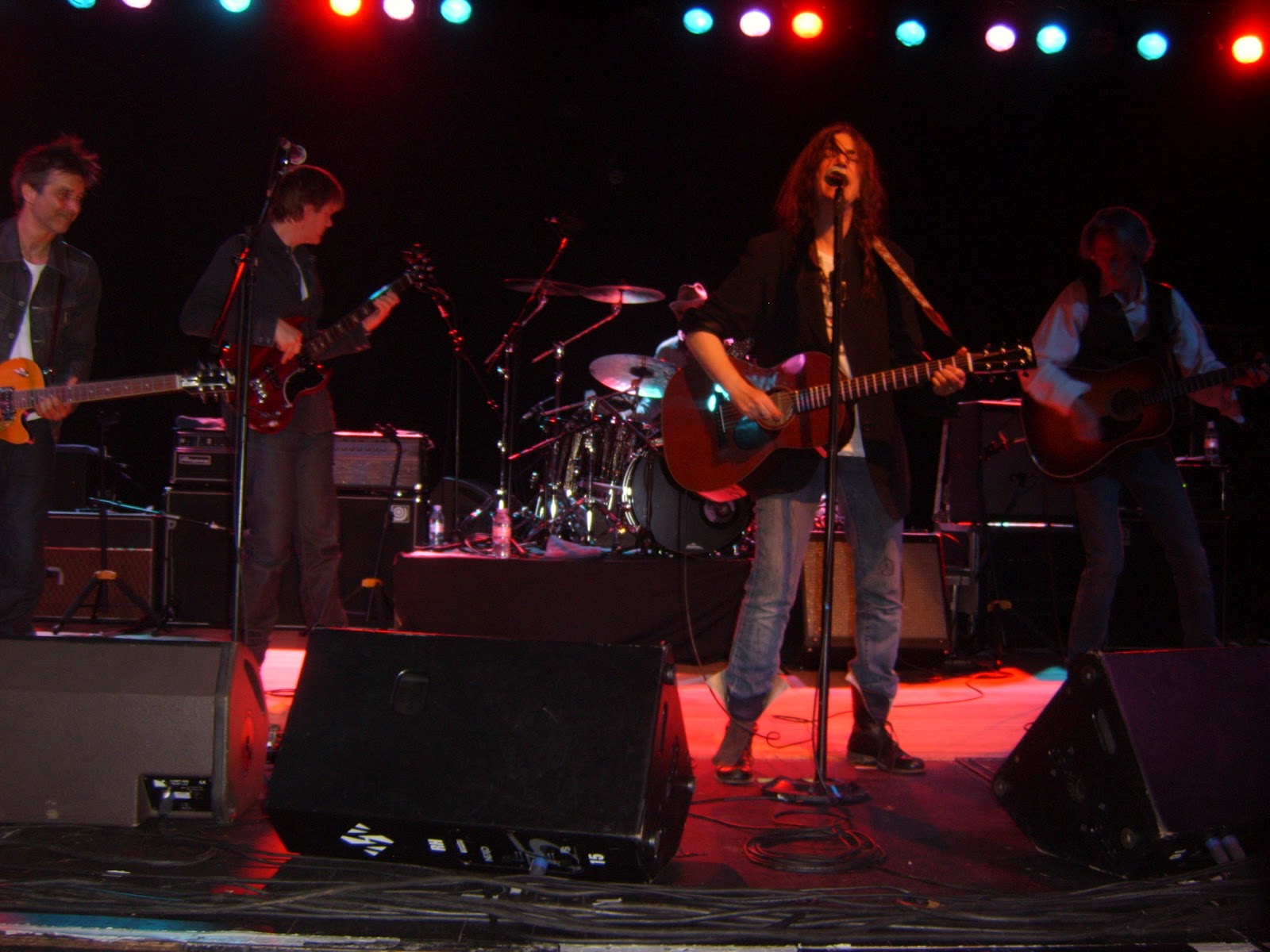
Smith live at the Wolverhampton Wulfrun Hall, 25th June 2012. The opening night for the 'Banga' Tour.

Does that mean the music industry is also marginalized nowadays?

"We just live in a different culture, some of it is good and some of it isn't. Some of it I think is unhealthy, some of it I think is confining. What some people feel is democracy is confining to others. I was talking to Neil Young a week or two ago and we were both talking about how in the past, the stage was your laboratory. You could go and do concerts but have a certain amount of time where you were working out new things... you didn't have lyrics or anything set, but you wanted to work out a song between you and the people, and it was really between you and the people. But now with technology, people post everything you do, they've already made a judgement on it before you can finish it and they make a judgement on you for not being together, for seeming like you can't remember your own lyrics when really you're just writing them with the people. Also you're subject to so much media. You go onstage and instead of feeling a oneness with the people you have to negotiate people filming you, taking photographs of you, recording you, looking at what they're recording, texting. I'm not speaking in judgement about it, but my concept of performance is connection and keeping our channels open, so one has to figure out how to negotiate the 21st century."

And how do you negotiate the 21st century?

"As a performer I could see the new people and what was coming. It's what an artist does, it's like when Walt Whitman said 'I am with you, young poet 300 years from now.' My concept was a little edgier perhaps, but it's the same idea. Art and self expression is infinite and after an artist dies his work fluctuates. It's like a bloodline." 

Is that part of the reason why the deluxe edition of Banga is also a book? 

"We put out a limited amount. I like the special edition because I like a book, the CD is relatively modern but it gives you the permanence of a book. I worked very hard on it. I think of all our records as sort of an oral book or an abstract movie. When you put records together it's like a soundtrack for a life, and I always put records together for people to listen to from beginning to end at least a few times. Each one of my records has the listener in mind to go through various things in listening: a certain amount of lightheartedness or joy, sorrow, fear or hope... there's a lot of things encoded in the record. It's a very sixties concept... it's meant to take you somewhere. Hopefully if you do a good job an album is like a drug, it takes you on a little trip." 

How did you feel being inducted into the Rock and Roll Hall of Fame?

"I was nominated seven times before I actually made it, so it's not like it was a big surprise, either they were going to fuck with me for the rest of my life or not. I didn't even want us to have a R&R Hall of Fame, when I was younger I lobbied against it. I thought rock and roll didn't need a hall of fame, we have our gods, but still we choose them. But they did make a hall of fame, they invited me in and I accepted. No matter what one thinks of these things, there's always a small amount of pride attached. In the whole arena of rock and roll to be chosen, whether one is cynical or not, for someone like me, it was obvious that someone like Elvis Presley would be there, I'm not an obvious choice.

 It's gratifying enough to know that what we did seems important to people. I always dreamed I'd write books, so it's very gratifying to know that it endured like a good book, and I'm proud of that."  
The Patti Smith Group as it is today. Left to right:Tom Verlaine, Tony Shanahan, Jay Dee Daughtery, Patti Smith, Lenny Kaye.

But your lyrics could read like a great poetry book... 

"Well I began as a writer, I'm not a musician. I write little melodies, I write a few songs by myself. I wrote Banga, but I don't think like a musician I think with language. Usually Tony, our bass player, or Lenny arranges them. If I write a song I do the whole thing because I can hear it from beginning to end. But often we will write a song on guitar riffs and arrange them together as a band."  

Wolverhampton was the first night of Patti's tour, which will go throughout the summer, and winter months. During the course of the interview ghostly sounds could be heard from the auditorium, alas, this was a technical glitch in the PA system. Not a good start to her tour. How does she cope with these things?

"These things happen, believe me. Soemtimes It's more harrowing than other times. I thought that I didn't get nervous but I've been realising that I have to take a piss a lot, and I find that that translates into nervousness. I have a really great band, we have great camaraderie. Sometimes I'll feel a little nervous when we're going into a place we've never been and I think "will anybody come"... then I go out and there's thousands of people. But that's my only worry, I still worry people won't come, but they do... oh, they do."  

By James Nuttall © 2012


Tour dates and news can be found at: http://www.pattismith.net/wegottofly.html

Many thanks to Patti Smith for her time and music...  

My signed copy of Horses- the first ever punk album, and the prototype for many to follow.


Saturday, 12 May 2012

Tweeting Music... by James Nuttall ©


KT Tunstall: Uummannaq Song. Built around synthesisers and a two-string guitar, Tunstall invokes the primal feel of the Greenland town. 

Marianne Faithfull: Broken English. Nicotine-stained vocals spouting words of war, Faithfull promises an unsmooth ride in her comeback LP. 

Lindsey Buckingham: Wait For You. The maestro of Fleetwood Mac adds layer upon layer of guitars to evoke what words could never say. 

Sheryl Crow: Ordinary Morning. Her second album, much heavier than the first, ends with this whirling pool of frustration and despair.

Kasabian: Secret Alphabets. One of the most eerie things you’ll ever hear, it’s worth buying the CD just for this tracks haunting melodies. 

Stevie Nicks: Planets of the Universe. She’s possibly the one woman on earth who can sing long-worded, pissed-off poetry and keep her cool. 

Cream: Crossroads. One day people finally realise that this song is about Jack Bruces pumping bass line that carries every Clapton solo.

Suzi Quatro: Strict Machine. Covering Goldfrapp, Quatro shows she’s still got the voice and killer bass-lines that took her to the top. 

Eagles: Hotel California. If you’re ever driving down the motorway at sunset, it should be a legal requirement to play this late 70’s album. 

Pink Floyd: Animals. If these guys ever stopped to take a breath, they might realise how boring and pretentious their elongated drivel is. 

The Clash: Lost in the Supermarket. A melancholy highlight on an otherwise overrated album, this is class for The Clash. 

Carole King: Tapestry. Back when women could sing without choreographed dancing and revealing outfits, King sings like a ‘natural woman’. 

Phoenix: Armistice. In a world where artillery is replaced by electric guitars on an Indie battlefield the French kick Britain into touch.  

Meg Baird: Friends. A soft Philadelphian vocal over a plucked guitar piece, Baird proves that all folk music needs is an acoustic guitar. 

Jimmy Destri: Heart on a Wall. It’s more faceless than the invisible man, but Blondie’s keyboardist and hit-writers solo LP is a winner.  

T’Pau: Bridge of Spies. It may not exactly be cool to like them, but I defy anyone to listen to Deckers voice and say they are not stunned. 

Florence and the Machine: Howl. Don’t get on the wrong side of Florence Welch; her voice will haunt you even if you haven’t pissed her off. 

Curved Air: Marie Antoinette. Sonja Kristina’s operatic voice weaves the French queen’s story brilliantly in the 1972 prog classic. 

Christine McVie: Northern Star. Put this on your iPod if you go for a walk on a lazy summer afternoon, McVie is the essence of soothing. 

Goldfrapp: Dreaming. Only Alison Goldfrapp could make electropop this sexy; she’s nearly 50 and gay- Rhianna would kill to be so seductive. 

Mike Oldfield: Tubular Bells. This is the ultimate musical journey; either the 48 minute track will take you to another world or to a coma. 

David Bowie: Space Oddity. Bowie lifts you into his stratosphere, using his two-way intercom vocals and ‘spacey’ melody. 

The Rolling Stones: Sway. Forget Brown Sugar, ‘Sticky Fingers’ is made by this improvised sounding swinger- not a first for the Stones. 

Janis Joplin: Try. More polished than Big Brother, but rocks first woman knocks the varnish off Kozmic Blues with those bitter-sweet tones. 

Blondie: Autoamerican. It’s got hip-hop, post-punk, 20’s pop, rap, techno, new wave and… jazz; so why does it work so well together? 

Foo Fighters: Wasting Light. Okay, so it’s got big guitar riffs and some memorable songs, but I don’t see what all the fuss is about. 

Arctic Monkeys: Mardy Bum. Infectious guitar riffs are ironically complimented with
Turners regional accent voice slurring out the lyrics. 

Tom Petty and the Heartbreakers: Something Big. Wonderful southern rock, beautifully arranged, but Petty sings like a goat with the flu.

Fleetwood Mac: Tusk. A 20 song double album and no filler in sight- get off the Rumours bandwagon already- it’s 1979, time for diversity.  

Kim Carnes: Bette Davis Eyes. As smooth and as cool as the actress it’s based upon- Carnes’ husky vocals brilliantly contrast the smooth synths.

Sheryl Crow: 100 Miles from Memphis. Sophisticated country- it could have been ripped from any Frey/Henley songbook for an Eagles record. 

Kim Richey: Just My Luck. If Dolly Parton was several bra-sizes smaller and, Kim Richey would rule the country/pop charts. 

Patti Smith: 25th Floor. Never before has the verb ‘spitting’ a lyric been better applied to a singer’s performance style. 

The Subways: Money and Celebrity. Juvenilia at its worst- this trio need to make songs that sound more sincere and mature. 

Elton John: Mona Lisa and Mad Hatters. The expression is just as prominent in the piano parts, as always, as it is in Johns lilting voice. 

David Bowie: Life on Mars. Bowies chorus cries disproves this theory… if there were life on the red planet they would have responded. 

Elvis Costello: Watching the Detectives. An element of Woody Allen in Costellos somewhat goofy vocal, blended with a killer bass line. 

Freda Payne: Band of Gold. A smoother Tina Turner, Paynes attitude slides right into this soul classic through a flawless vocal. 

Espers: Dead Queen. Psychedelic, dark Philadelphian folk, Espers have the potential to conquer the world of music for seances.

Kirsty MacColl: A New England. An upbeat pop moment for an otherwise new-wave toughie, MacColl should have played the pop card more often. 

Jefferson Airplane: White Rabbit. Jack Casadys bass tone tells you you’re in for the trip of a lifetime; Slicks voice entices you even more. 

The Byrds: Eight Miles High. Low buzzing harmonies make you feel like you’re just taking off from a 3 minute long runway. 

Led Zeppelin: Going to California. It’s the calm before the storm (When the Levee Breaks) in one of the 1970s definitive rock albums. 

Oasis: Acquiesce. Guitar-driven 90s rock, great to hear Noels voice on the chorus contrasting little brother, Liams, voice on the verses. 

Haight-Ashbury: Freeman Town. They may be from Glasgow, but the two sisters voices sound as free as the town the band is named after. 

Rae Morris: Walls. Sophisticated lyrics for a 19 year old, Morris’s voice only needs a piano for support in her deep and intense ballads. 

Dire Straits: Heavy Fuel. If this song came along 15 years earlier it would have had more impact. Most of it’s been said time after time. 

Jackson Browne: Running on Empty. If you want a west-coast taste of what it was like to be on the road in the 70s, this is the LP to get. 

Fairground Attraction: Perfect. A fusion of jazz and pop, Eddi Reader’s voice controls the swing of the whole song- she’s sharp and soft. 

Nick Glider: Roxy Roller. Bubblegum pop has a sprinkling of grit to it, as Glider trips through the bouncy rock ditty. 


By James Nuttall


Friday, 16 March 2012

Five Faceless Gems- By James Nuttall ©


1. Christine McVie: In the Meantime


The McVie's always were the modest two in Fleetwood Mac. At the height of their success, John McVie's dress sense was the only thing that made him stand out, wearing garish Hawaiian t-shirts for performances, preferring to stand at the back of the stage, quietly pumping his bass-lines out. And rather than worry about solo alums, he was content to record his bass parts early in the Mac's mixes so he could go sailing. 


Equally, Christine was never very comfortable in the limelight, preferring to be at the side of the stage behind her array of keyboards, letting 70's sex-goddess Stevie Nicks take the bulk of attention.  


McVie has released three solo albums in her career, the first in 1970 before she married John, simply entitled 'Christine Perfect.' The second came in a large break between Mac albums in 1984. It had two hit singles, and peaked at number 26 on the billboard chart.


McVie left Fleetwood Mac and returned to England in 1998. Until 2004, she had nothing to do with music at all. That year, however, she released a real masterpiece of easy-listening, 'In the Meantime'. She did little to promote the album, other than a limited number of UK and US interviews. Without one live performance it nestled comfortably at number 133 in the UK charts for a few weeks.  


It opens up with the exciting 'Friend', which finds McVie still in fine form, both as a piano player and singer. The song 'You Are', which was the instigator of the album being made, sounds as though it could have come from any Fleetwood Mac album.


She collaborated with her nephew, Dan Perfect, who gives us one of the albums best songs, Northern Star- perfect listening for a walk on a lazy summer afternoon. Another highlight is the funky 'Anything is Possbible', and the moody 'So Sincere', both of which give the album its attitude. 


Available to buy at: 
http://www.amazon.co.uk/In-The-Meantime-Christine-McVie/dp/B000CR89VI/ref=sr_1_8?ie=UTF8&qid=1331922820&sr=8-8

2. Jimmy Destri: Heart on a Wall


Today this album is more faceless than the invisible man... not that it was much different on release.


Jimmy Destri is known for being Blondie's original keyboard player, and composed many of their biggest hits, including 'Picture This', 'Maria' and 'Atomic'. 


Destri released 'Heart on a Wall' in 1981 at the height of Blondie's success. It peaked at number 201 on the US billboard charts, but despite featuring the other members of Blondie guesting on the album it did little anywhere else. 


The opening track, 'Bad Dreams', is the essence of Destri's writing style. It may not necessarily make sense all the way though, but certainly shows off Destri's skill as a writer and a singer. 


'In My Own Little World' is reminiscent of Destri's contribution 'Living in the Real World' on Blondie's 1980 LP 'Eat to the Beat', as is the album's highlight 'Numbers Don't Count (On Me).


As of yet, the album is still to be released on CD.


3. Espers: II


If you're looking for psychedelic-folk/drone music, look no further than Espers. Based in Philadelphia they have released four critically acclaimed studio albums, and have a large cult following. 

Their albums however see little promotion upon release. 'II' is their finest example of the members of the band working together to create a compelling piece of art that leaves spellbound. 


The highlight is arguably the albums opening track, 'Dead Queen'. Meg Baird is in fine voice as she serenades us with her harmonies with Helena Espvall. 


Available to buy at: 
http://www.amazon.co.uk/Espers-II/dp/B000FQITT8/ref=sr_1_4?s=music&ie=UTF8&qid=1331923358&sr=1-4


4. Kim Richey: Kim Richey 


Kim Richey's first album scraped it into the USA country albums back in 1995, and scored a moderately successful single with 'Just My Luck'. 


Although she was nominated for two Grammys for songwriting, she is a widely ignored talent. 


Her first album boasts her talent as a songwriter and a singer. Aside from the catchy and upbeat single, songs like 'Sweet Mysteries' and 'Those Words We Said' helps to make this album one of the best country albums of the 90's. When you think of how many women there are around now who take the stage with an acoustic guitar around them to sing country... surely some of them must have been influenced by Richey's talent. 


As Steve Horowitz of popmatters.com wrote: "Kim Richey would rule the charts in the land where Marshall Crenshaw was king, Aimee Mann queen, and The Beatles never put out another record after Revolver." True. 


Available to buy at:
http://www.amazon.co.uk/Kim-Richey/dp/B000001ED5/ref=sr_1_7?s=music&ie=UTF8&qid=1331923996&sr=1-7


5. Suzi Quatro: Rock Hard 


Suzi Q has covered a smorgasbord of genres when it comes to making albums. Her first album was warmly received by the critics and sold very well worldwide despite her biggest single, Can the Can, being left off it apart from in Australia. 

Her second album, 'Quatro', was poorly received by the critics and didn't sell as well as the previous album. Although it topped Australia's charts for a full six weeks, the absence of her second number one single, 'Devil Gate Drive', on the album meant that it failed to chart in the UK altogether. It screamed 'rushed follow-up' to the success of the first. Littered with 1950's cover songs and self-penned slow-movers, 'Quatro' proved to be a commercial failure. 


In later years she would fuse country and techno together in the 1982 album 'Main Attraction', funk in 1975's 'Your Mamma Won't Like Me', and she even had a nod towards prog in 1976's 'Aggro-Phobia'.


In the late 70's both Quatro's image and music softened. The cover of the 1978 album 'If You Knew Suzi' signifies this change: gone with the leather jumpsuit and tough look, in with the soft long hair, corduroy trousers and black boots. 1979's 'Suzi... And Other Four Letter Words' took on the same style.


In 1980, however, Quatro released what most critics called her rockiest album up until the time. 'Rock Hard's' cover signifies this. It shows Suzi Q with her long, long hair, leather jumpsuit and tough-girl stare. This is complimented with her sporting her custom made BC Rich 'Bich' bass guitar. Robert Palmer would later credit Quatro with his decision to use these guitars in his award-winning music video of 'Addicted to Love'.


The album itself is a platter of hard-rock tracks, including a re-vamped cover of the Dave Clark Five's 'Glad All Over'. The Quatro/Tuckey songwriting team are on fine form, contributing five of the 11 tracks: the albums ballad, 'Lonely is the Hardest', the reggae-styled 'Woman Cry', and the guitar-driven 'Ego in the Night', 'State of Mind' and 'Lay Me Down'.


Her original hit songwriter, Mike Chapman, offers the two singles: the title track, which hit number 68 in the UK and number nine in Australia, where the album went platinum, and 'Lipstick'. 


A songwriting team of Brown and Straley composed the remaining three tracks.


This record was somewhat overshadowed in most countries by the 'Suzi Quatro Greatest Hits' album of the same year, which hit the number four spot in the UK. Until 2012, it was only available on CD on the German double-pack 'then and now', or with different album art. Now Cherry Red Records are finally releasing 'Rock Hard' in its own right, and for the first time ever with the original artwork. 


This album is a jewel in Quatro's crown as the queen of rock and roll, and many fans deem it to be her best work. 


Available to but at:
http://www.amazon.co.uk/Rock-Hard-Suzi-Quatro/dp/B007FGQ06U/ref=sr_1_7?s=music&ie=UTF8&qid=1331916638&sr=1-7


By James Nuttall


Tuesday, 13 March 2012

"Singing is what I love best." Rise to Kim Richey- By James Nuttall

In the words of Steve Horowitz of popmatters.com: "Kim Richey would rule the charts in the land where Marshall Crenshaw was king, Aimee Mann queen, and The Beatles never put out another record after Revolver." One only has to put on her debut album, Kim Richey, to understand what he means.


Richey has been nominated for two Grammys for songwriting,  one of them being nominated for Song of the Year. She has has a hand in writing songs for the Dixie Chicks, Trisha Yearwood and Patty Loveless, and collaborated with Ryan Adams. Top this off with her music has also been played on Buffy the Vampire Slayer and appearing on the Angel soundtrack, Richey has developed quite a cult following.


Before her gig on 4th March, I spoke to her about her career, and future plans.


Have you enjoyed touring the UK this time around?


"Yeah, quite a bit. I do it quite often because I've been living in London for a while. I've been going back and forth between Nashville and London but then I decided to kinda be over here more; but I love it over here, I'm having a great time."


Out of all your albums does one stand out to you?


"Well, you know they're all different, that's what I like about them. The first one will always be a really great experience for me because I'd never been in the studio making a record before, and I got to work with Richard Bennet and he played a lot of guitar on my records. He was wonderful to work with and I had so much fun on that first record.


I really loved working with Bill Bottrell on the record called Rise."


What do you listen to when you're not on the road?


"You know, I don't listen to a lot of music. I listen to a lot of pod-casts, just trying to keep up with news, and I'm always working on songs.


I've just been over in Australia for about five weeks before I came here and I really loved some people that I heard over there playing at a festival. One guy was called Shane Nicholson, he just has a new record out and I love that, so I've been listening to that a lot, and he's married to Kasey Chambers and I really like what both of those guys are doing."


What has been the highlight of your career?


"I've met a lot of people that I never thought I would have met. I've traveled a lot. I never would have been able to travel as much as I have and seen as many things without being in music. I got to meet Dolly Parton, she's fantastic, and all kinds of people like that. But I think the thing I love the best about it is just to be able to do it for as long as I have; and also to make music with other people, and to sing and play with other people, and with a whole band around you it's pretty amazing. "


Is there anyone you've particularly enjoyed working with?


"I wrote for the Dixie Chicks, but it was before Natalie Maines joined them, so they weren't the gazillion-selling Dixie Chicks, they were the two sisters and another girl who's not there anymore. They used to sing old country and western songs, so it's kind of a different band. I loved singing with Ryan Adams on Heartbreaker. That was a great thing. And I did a little tour with him so we got to sat up a writers-type show, so I got to sit up and sing with him all night on those tours."


Who influenced you to pick up the guitar?


"Well, my mom bought me a guitar for Christmas, and I'm not sure why! But it was a really cheap, bad guitar and she probably got it at a drug store. I remember it had an old, plastic, zippy case. But when I was about 12 we went to a guitar store and it was a Valentines Day present, and I got a hollow-body electric, it was really great.


I mostly started playing guitar so I could have something to sing with, because singing is what I love best "


So how do you write a song now?


"I'll play with music a little bit and then that will inspire me and an idea comes from that. Recently in Australia I wrote with this girl who is just a lyricist. She had a verse and chorus idea she said "We need music." I was just like "Where do you start?" I couldn't figure it out because the word go into the music for me. We figured it out in the end, but it was a different way to work."


So on the road or in the studio?


They're different. The studio's great because you just kind of hide out in it, and it turns into your whole world. You're in their with friends and you're making music, and just trying all these really great creative things. The studio's like a bubble. If you're a escapist in any way, shape or form the studio's a great place for you to be because you're not taking phone calls, you're keeping up with stuff because you're in the studio! You'll stay in there for hours on end and you can just get lost in it, which I love.


With performing live... when it really goes and there's this connection going back and forth between you and the audience, that's a really amazing, immediate kind of high jolt. They're different things and I really love both of them"


What are your plans when you finish the UK tour?


"I have about five weeks of touring in the States, so I'll be over there doing shows straight from here. I'll stay here and do some writing for a couple of weeks, and I'm going to go to Copenhagen and do some writing over there. I have a friend who I write with, who has a record out now that's doing really well out there, we're going to do some more work.


Then I'll go home to Nashville and I think I'll probably set up house over there in the Spring. I gave up my apartment in London this summer because I had the chance to stay in Stockholm. I've just been homeless touring, which maybe sounds more fun than it is! When you're not touring and you've got to stay with friends, or at your family's house... it's not very relaxing. And you can't keep track of your stuff! I don't know where most of my stuff is."


Richey sounds yet to fully settle into the British culture. The night before the interview she wrote on Facebook: "‎Wife swap starts in 30 seconds according to the guys out in the hall. I think it's a TV show. I hope it's a TV show."
"That was a noisy hotel I was in last night! I didn't go to bed until about two, and they were still at it all over the place."

If you could pick anyone to work with, who would it be?

"God, that's a good question. I'd love to sing with David Hidalgo. I love his voice. I'd love to make a record with Bill Bottrell again. 


I love singing with people. In a perfect world for me I wouldn't be the lead singer, ever. I love singing harmonies with people." 


Somehow we venture off topic towards the end and discuss her out-of-date Wikipedia page. "Wikipedia's just crap! I can't even go on my page, it makes me so mad when I look at it. It's just wrong! Don't even get me going on Wikipedia. 


Commenting on plans for a new album, Richey said: "We haven't started anything yet, but I think July we're starting. We were going to record in December, then we were going to record in May and I just said that I couldn't even think about doing it until I get settled. 


I've got a lot of songs. I always keep writing, right up until the end. I've got a lot of old songs that maybe other people recorded and I never did, or songs that were maybe more country than the records, so didn't make it on that I really like." 


Kim Richey's music can be purchased at: 
http://www.amazon.co.uk/s/ref=nb_sb_noss?url=search-alias%3Dpopular&field-keywords=kim+richey&x=22&y=23 


Follow Kim at: 
http://www.kimrichey.com/ 
http://www.facebook.com/kimricheymusic
https://twitter.com/#!/kimrichey 


By James Nuttall